

The memo went out on the Wednesday, one day after the announcement, to all 211 of FIFA’s member associations, from the Football Association of Ireland to the English FA, all the way down to the Cook Islands, and it had a simple request: agree by September 19 to sell a piece of the World Cup. Or else.
In return, each association was offered a dividend early next year of somewhere between twenty and forty million dollars. Fifty-three days to think about it. With a highlighted, double-underlined sum of money at the bottom of the page that, for most of the federations receiving it, would exceed their entire annual operating budget by an order of magnitude and clear all sorts of debt, transforming their financial horizons in an instant.
A source speaking to Inside World Football went with the obvious; “bribery”.
The thing being sold was called the FIFA Forward Enterprise, which sounds more akin to a mid-tier trucking logistics firm. Underneath it was everything that earns FIFA cash: World Cup broadcast rights, sponsorship, ticketing, licensing, the operational delivery of the tournaments themselves, and the Club World Cup as well for good measure, all bundled into a new commercial subsidiary valued at twenty billion dollars.
Up to a fifth of it was going on the market, which works out at $4.2bn in fresh capital. Greg Maffei, who spent years turning Liberty Media into a machine for extracting value from Formula One, helped tease out the details. The expected lead investor was Thrive Capital, the fund run by Joshua Kushner, brother of Jared, son-in-law of the sitting US president, through a vehicle called Thrive Eternal. Somewhere in the documentation, “tokenised equity” was floated as a potential option. Because of course.
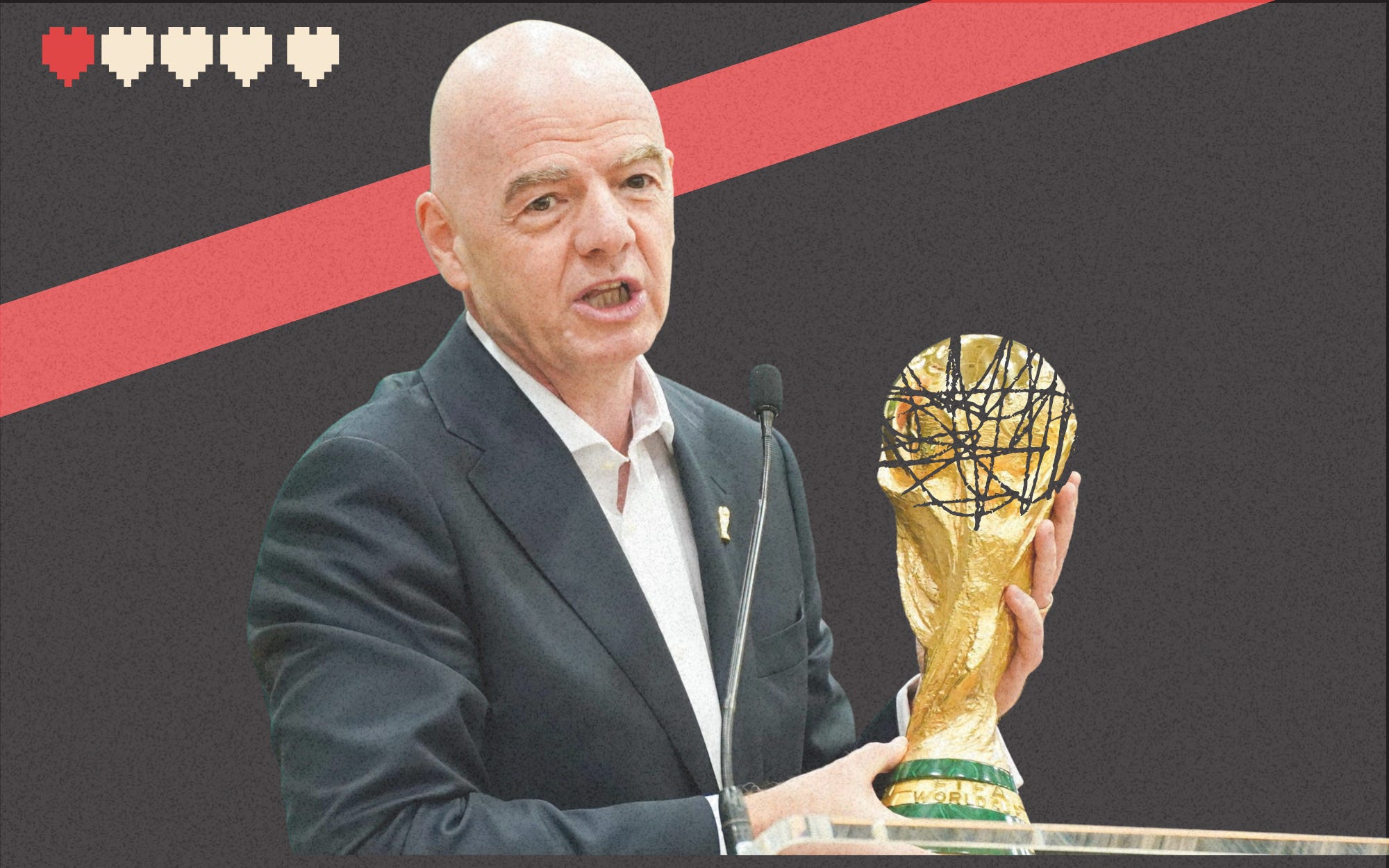
For nine years the criticism of Gianni Infantino has been that he treats the World Cup and football in general as an asset rather than anything with a semblance of sporting integrity that must be managed for the greater good of society. He wraps it all in nonsensical clichés about growing the game and bringing the sport to every corner of the world, when in reality his goal, now firmly seeing the light of day, was only ever about greed. He rubbed shoulders with the great and powerful, building up enough insulation until he could pull the trigger on his grand vision for a highly-monetized World Cup, where the private market profits from the goodwill of the greatest sporting tournament ever concocted.
What happened next sent shockwaves through the recently-blockbuster Football Administration network. By Thursday, two days after the plan had leaked, UEFA’s fifty-five member associations had met and voted unanimously, which almost never happens, to boycott every FIFA competition, men’s and women’s, if the thing went ahead.
Their statement did not hold back. “The World Cup cannot be treated as an investment product... No part of it should ever be surrendered to private investors. The World Cup is not for sale.”
CONCACAF’s forty-one members rejected it the same day. The AFC, whose backing Infantino has relied on since he beat Sheikh Salman by twenty-seven votes in 2016, called the lack of consultation “totally unacceptable” and asked for an urgent review of FIFA’s governance framework, which in the language of these bodies is roughly equivalent to changing the locks.
FIFA’s response on Friday morning was to blame the press. “Our planned consultation process was disrupted by incorrect media reports,” the statement read, and they would be proceeding with the consultation regardless.
By Friday evening, Infantino’s swanky Trump Tower office was ablaze and the rats were scattering from the wreckage. Carlos Cordeiro, Infantino’s own senior adviser and his handpicked man on the White House task force for the 2026 tournament, resigned with immediate effect, called the plan “a bad deal for football”. Kevin Lamour, FIFA’s chief operating officer, said staff had been deceived and described FFE as “a project of one person”. Late that night, Infantino killed it and apologised for the division it had caused.
Despite wilting, UEFA declared they had lost confidence in him anyway.
“We cannot keep going on like this with secret schemes on fast-track timescales, cooked up by faceless individuals and of dubious benefit to the game.”
On Tuesday UEFA confirmed it had served FIFA with a document preservation letter. The Times reported that UEFA, CONCACAF and the AFC were now aiming to force Infantino out by paralysing FIFA, and by starting their own competitions if he won’t go. Five European associations, England’s FA among them, have formally withdrawn their support for his re-election. Denmark noted they were never going to vote for him anyway.
Inside the building, Mattias Grafstrom sent staff a memo about a “sad and reproachable series of events” and reminded them that “individuals, unstable moments and unfortunate episodes come and go”, which is a remarkable thing for a secretary general to circulate about a president who has not, as yet, gone anywhere.
Arsène Wenger, FIFA’s chief of global football development, put out a statement clarifying that he learned about the plan from the media, same as the rest of us, and that withdrawing it was “absolutely necessary and beyond question”. Anyone with any stake in FIFA were issuing their own personal press releases to distance themselves from Infantino and his carefully crafted, but equally hair-brained idea.
So does he survive? Sadly, probably.
The immediate threat is an Extraordinary Congress, which requires forty-three member associations to submit a formal written request. Forty-three out of 211. It sounds achievable until you remember where FIFA’s votes live and where Infantino has been building his base, similar to his predecessors: outside Europe, among associations for whom FIFA development money means everything to them. The Faroe Islands and Fiji get one vote each, exactly like Germany and Spain and Brazil. That is the founding principle of the thing, and it is also, in the right hands, a weapon to maneuver and pedal cushy deals with. From the moment the plan was hatched and millions and millions of dollar were dangled, Infantino understood precisely who would find that hard to refuse and who wouldn’t.
Now, he’s desperately trying to energise his base. Morocco, Qatar, Kuwait, Lebanon and Sri Lanka have publicly restated their support, and Infantino has been amplifying every one of them on his Instagram.
African administrators have sent messages of backing; CAF, with fifty-four votes, meets on Thursday, and by the time you read this we may know more on Infantino’s future.
FIFA has dismissed as “pure fiction” a report that he approached the Trump administration for help staying in post. He has until November 18, the nomination deadline, to make sure nobody credible files against him, and until the Congress in Rabat next March to make sure they lose if they do.
Sepp Blatter has put forward Lise Klaveness of the Norwegian FA, who has spent years being one of few in these rooms willing to push back on the nonsense. And yes, there is a great deal of irony that this comes from Sepp Blatter.
But seven months is a very long time in an industry where the business is a 24/7 factory of football and memory is a function of where the latest cheque can be cashed.
And while this fire blazes, other ideas press ahead. FIFA’s review of a sixty-four-team 2030 World Cup is still scheduled, with a decision point on August 14 and full analysis due September 11. More teams, more matches, more inventory, more associations with a reason to be grateful should they qualify, buffering even bigger stakes in a Gianni Infantino-led FIFA.
For now, what Infantino is trying to sell is the one part worth clinging onto.
Three weeks on from Spain’s success in New Jersey, the World Cup remains stubbornly, irritatingly good in spite of the people who run it, and that it should never be taken from the players, the fans and the world at large.
By backing Infantino, Trump ends up adding even more pressure to an already messy FIFA situation.
As an American who does not follow soccer obsessively, I have always thought he looks like a Bond villain. Seems like he acts like one too