

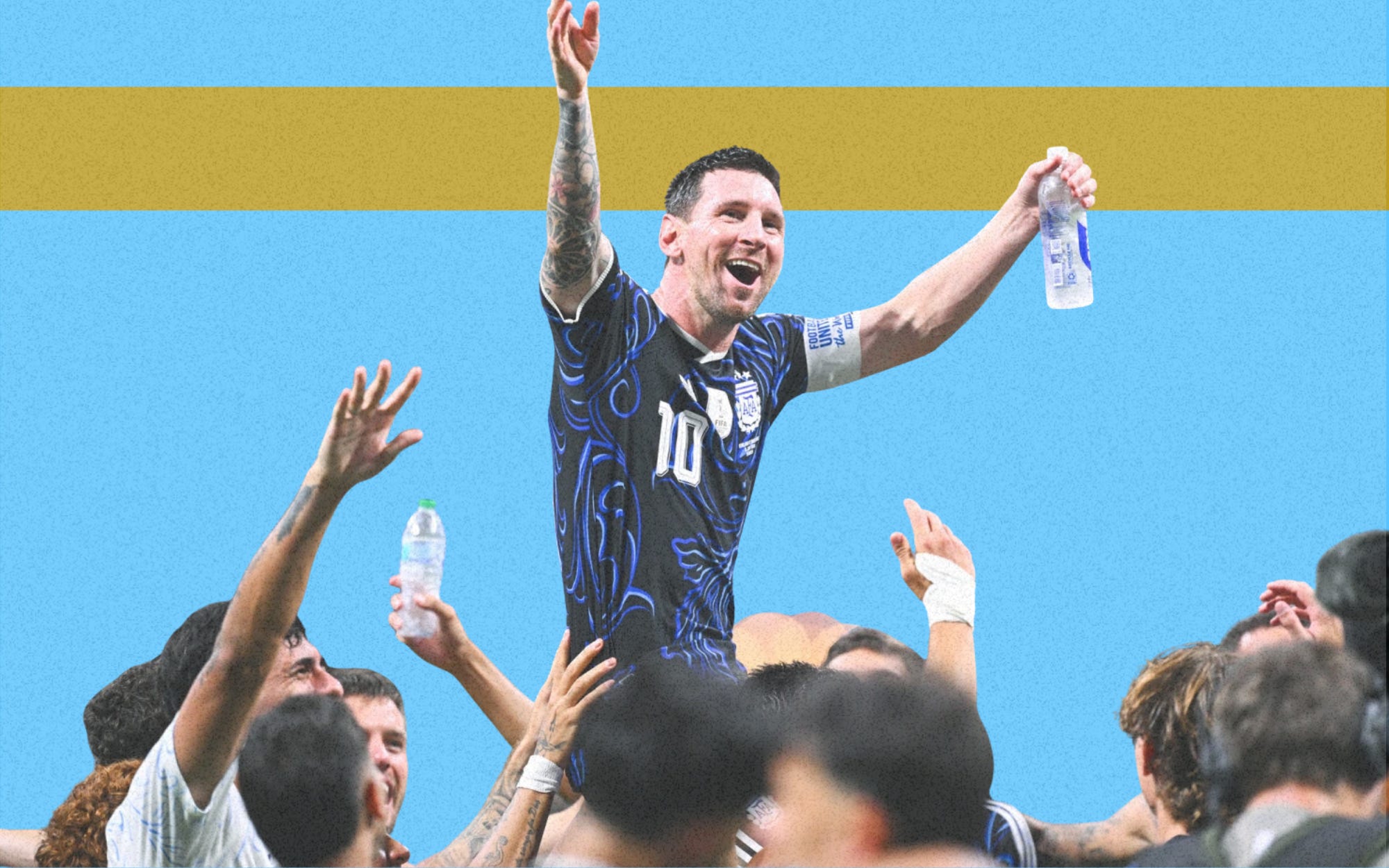
A stupid amount of football has happened since, but there is a moment in Argentina’s Round of 16 tie with Egypt worth looking back on.
Argentina are 2-0 down and the television directors are earnestly cutting to a forlorn Lionel Messi, chopping content for the inevitable end-of-era montages. He is 39 years old, after all.
Then he puts a ball on Cristian Romero’s head in the 79th minute, equalises himself four minutes later with a goal out of nothing, and Argentina score a third in stoppage time. Egypt are defeated and Argentina, by the skin of their teeth, are through, having already barely survived a Last 32 scare against the minnows of Cape Verde.
On Wednesday against England he did it again. In a clip that’s now become memeified, Messi and Jude Bellingham chip at each other and the Real Madrid player clearly irks Messi, who nods in that sort of Michael Jordan “and then I took that personally” manner.
Two assists from Messi later and Argentina are in the World Cup final. Again. England, from a position of 1-nil strength, somehow handed all the momentum back into the almost mythic figure who had turned 39 during the tournament and had proved along the way, with his army of manic disciples, that they were never going to roll over too easily.
There will be several comments from the hip this week which tells you this settles the greatest-of-all-time argument. But that debate has been long concluded - Lionel Messi was the greatest football player of all time before the tournament kicked off and has simply highlighted and double-underlined that fact throughout the summer. Messi is the greatest ever.
When his meaningful participation at 39 was in doubt, Lionel Scaloni’s response was to sit down with the man and the medical staff and work out, in cold practical terms, what a 39-year-old body could give and how to build around it. There’s no ego or inclusion for inclusion sake, nor a pitiful ceremonial role. He’s not an anchor on the team, a top-heavy piece weighing down the team, selected on reputation alone.
Argentina had an actual plan, with the squad constructed to carry the running and the bite and the fumes, granted Messi has still managed to exert plenty of that, so that his passing and the finishing and his genius when the moment needs it can happen.
The trust between manager, Messi and squad is the ultimate backbone of why this all works for Argentina. Some strokes of luck and the odd debatable referee decision aside, the identity of this squad is what has set it above all else.
Half of Argentina’s eighteen goals at this tournament have come after the 75th minute. A team that has a collective ability to never die, with complete and utter trust between the mere mortals surrounding Messi to keep going, knowing when the moment is needed he’ll be there.
Cape Verde pushed them into extra time. Egypt nearly beat them. Switzerland pushed them all the way and England had them desperately launching attacks with the clock ticking.
None of this should diminish what Scaloni’s squad are about themselves. Rodrigo De Paul, Alexis Mac Allister, Enzo Fernandez, Romero and the rest are serious footballers who would grace any team, and it would be a disservice to cast them as extras in one man’s film.
Trust is a massive cliché in sport, for sure, but it runs through the veins of this team. Messi trusts them to do the work of a football team; they trust him to do the thing that only he does; the manager trusts the whole arrangement enough to win games and stake back-to-back World Cups.
To Sunday, then. Spain have conceded once all tournament and kept six clean sheets, which is a record, and by any sensible reading they are favourites: younger, fresher, better organised, with the ability to dictate games and slice through teams with consummate ease when legs are ailing.
If Argentina win they become the first back-to-back champions since Brazil in 1962, and the tales will write themself. Messi will set off into the sunset with two World Cup trophies and a culmination as one of life’s greatest icons.
If Spain win, all is not lost. This Argentinean side entertained all tournament, brought all the drama, thrills and tournament-defining moments, and Messi’s summer becomes a beautiful footnote for the history books.