

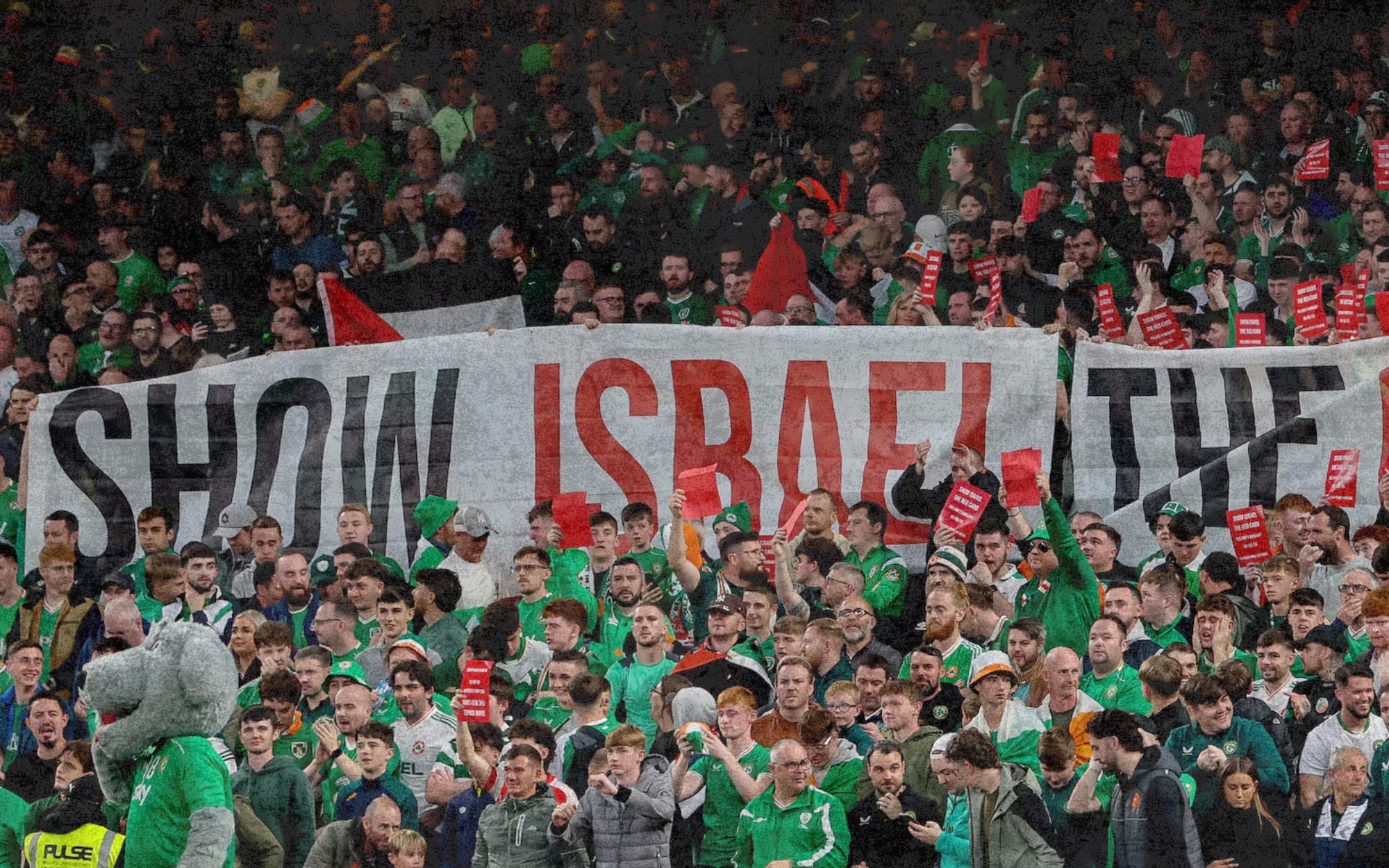
This international window, Ireland are scheduled to play two competitive senior men’s Nations League internationals against Israel.
Sunday, following their away fixture against Kosovo on Thursday night, Ireland travel to Debrecen in Hungary to play the first of the two games.
A week later, after a home tie with Austria, Ireland will travel to the modest TSC Arena in Bačka Topola, Serbia, where they have moved their home tie to neutral turf.
Not in Dublin, not in the Aviva Stadium. Instead, banished miles away from fear of security concerns and raucous local protest, where no tickets will be sold to Ireland supporters for either game. The ‘home’ game will be played behind closed doors, and only Israeli fans will be at the Hungarian game.
The national broadcaster, RTÉ, although contractually obliged to show both games, will deliver no studio presence, pundits or local commentary, and the broadcaster has opted not to sell advertising or sponsorship for the fixture.
Everyone involved is working tirelessly to make these two matches go ahead with as little fanfare and attention as possible. As soon as the draw was made earlier this year, pitting Israel against a nation that has been passionate and steadfast in its support of the Palestinian people, the game instantly became a problem for the FAI and UEFA, as well as a political football for several elements both domestically and internationally, and put the microscope firmly on Ireland to act — either play, against all its moral and ethical fibre, or not play and open up the can of worms that no footballing nation has been willing to countenance to date. All because UEFA, somehow, have not removed Israel from the equation.
When this much effort needs to happen for the games to go ahead in the first place, they probably, simply, should not go ahead at all.
And why the game shouldn’t go ahead is because Israel are engaged in an ongoing and active genocide of Palestine.
The numbers make for grim reading, but should be noted nonetheless — the Palestinian Ministry of Health said on Monday that 73,914 people have been killed in Gaza since October 2023, and 174,952 injured. Compiled figures put the number of children killed in Gaza at over 21,500, and 1,193 people killed in Israeli attacks in the West Bank, 251 of them children, as of late August.
A ceasefire has been in place for almost a year, but the ministry counts 1,394 people killed since it began. Last September, an independent UN commission concluded that Israel has committed, and continues to commit, genocide against Palestinians in Gaza. Israeli authorities, of course, rejected the report’s findings. The world’s leading association of genocide scholars has also agreed that Israel’s conduct meets the legal definition of the crime.
Russia, the previous bellwether in UEFA’s handling of international wrongdoing, were thrown out of European competition immediately following the invasion of Ukraine, and continue to be four years later.
UEFA was reportedly moving toward a vote to suspend Israel last September, but the motion was put on pause. The FAI approved a motion in November calling for Israel’s ban, alongside the Norwegian and Turkish federations, but those motions were rejected.
When the FAI asked afterwards to be kept apart from Israel in future draws, FAI CEO David Courell was told it wasn’t possible because Ireland and Israel have never been in direct conflict. UEFA later said these decisions are made case by case and guided mainly by security considerations, and that the body that governs European football has a rule for keeping apart countries that have been in conflict with each other, but no such measures for a country credibly accused of genocide.
Granted they have been put in a difficult position by UEFA, that shouldn’t let the FAI off lightly. Within minutes of the draw being made, the FAI confirmed that it would fulfil both fixtures. The association that wanted Israel banned in November were ready to play them three months later.
Courell’s public defence of the position has been diplomatic and, from his point of view, logical, in an attempt to remove emotion from the decision and towards earnings, rankings, rules, and the knock-on impact for other Irish teams should they draw Israel again down the line.
The FAI says not fulfilling the fixtures would cost around €5.5 million in direct costs, make relegation to League C more likely (a concern which has since been mitigated, with the introduction of a relegation/promotion play-off between League B and C).
In July it also warned members that a boycott could lead to exclusion from the entire Nations League and from future UEFA and FIFA competitions. Yet Courell has also said there was no threat from UEFA to Ireland’s Euro 2028 hosting duties had the FAI boycotted. He says the lack of action from UEFA has left the FAI in a “really difficult position”, and that he “can’t just take my FAI CEO hat off”. The FAI’s general assembly backed proceeding by 75 votes to 32. Meanwhile, the Dáil, Ireland’s government, voted 81 to 68 against Ireland playing Israel at all.
It should be maintained that none of this is the players’ fault, and they are the ones likely to take the brunt of the heat over the next few weeks should the games proceed. Back in May, Seamus Coleman, then captain, said the players were uncomfortable having to play Israel. “It should have been dealt with above us,” he said. Director of football John Martin has asked opponents of the games not to blame the players: “People like me and David Courell made this decision, not the players.”
He’s right, and the consequence is that a group of footballers has been left to dwell on shaking hands with opposition players, and personal or unified protests in a game that will have the eyes of the world on it. The players have said nothing publicly so far and the squad are expected to cut back media duties to the bare minimum over the course of the three week break.
The pressure from within Ireland hasn’t let up since the draw was made. In May, Stop The Game protesters briefly halted the friendly with Qatar by throwing tennis balls onto the Aviva pitch. In July they occupied the reception of the Department of Sport offices until being removed by gardaí. On Monday, protesters gathered outside the team hotel in Dublin with signs reading “no sports-washing Israel”.
More than 160 Irish sportspeople have signed an open letter urging the squad to refuse to play, including former manager Brian Kerr, World Cup hero Pico Lopes, as well as former player Kevin Kilbane, who wrote an impassioned piece on the matter for the Irish Times. Lopes said the loss of life in Palestine has to take precedence over any sporting consideration.
Manager Heimir Hallgrímsson said it plainly at the squad announcement last week, “We are not playing with genocide, we are playing against genocide”, but rowed back from that slightly when the Israel FA heavily criticised the message.
Israeli sentiment online has already been mobilised, while several online commentators, both public and behind anonymous profile pictures, have begun reframing the argument as Ireland being outwardly antisemitic, in an effort to downplay the facts and statistics that document the genocide.
The Israel FA’s official account also seem to be activating a strategy to criticise the Irish team’s actions — boasting of Israel’s contributions to humanity and its Nobel Prizes, saying it hadn’t yet found a cure for the Ireland coach’s “stupidity, ignorance and hypocrisy”.
It signed off by saying they were playing “against the coach who embodies them.” Israeli media reported the Israel FA was considering a complaint to UEFA, while the players will reportedly refuse to exchange jerseys with Ireland players after the game — in one way, doing the Irish team a favour.
So, at the time of writing, the games are going ahead. It’s hard to see any good coming out of it. Even if Ireland win both games, they’ll have lost, and history will remember the team that didn’t take a stand. They have a chance to do something powerful that will reverberate around the world but it’s a lot to ask of a group of young men and I have sympathy for the situation they’ve found themselves in. As Ed Sheeran’s backup artists have seen following their stance, people of power can push the scale and the show will go on regardless. All fingers should be squarely pointed towards the leadership who have so profoundly let them down.
Ultimately, this all continues to be a distraction and a sportswashing endeavour that takes attention away from the atrocities at hand. As long as insults are being barbed back and forth and media and online sentiment muddies enough water from the killing of Palestinian civilians, the Israeli government will consider it a job well done.
Football, it’s been said, is the most important of the least important things. UEFA and worldwide leadership have allowed Israel to go about their footballing business this week, and Irish football will become complicit in that.
This week I’ll be thinking of Hind Rajab, the six-year-old girl who, along with six of her relatives and two paramedics, were killed by Israeli soldiers in 2024.
An estimated 335 rounds were fired at the vehicle she was travelling in.