

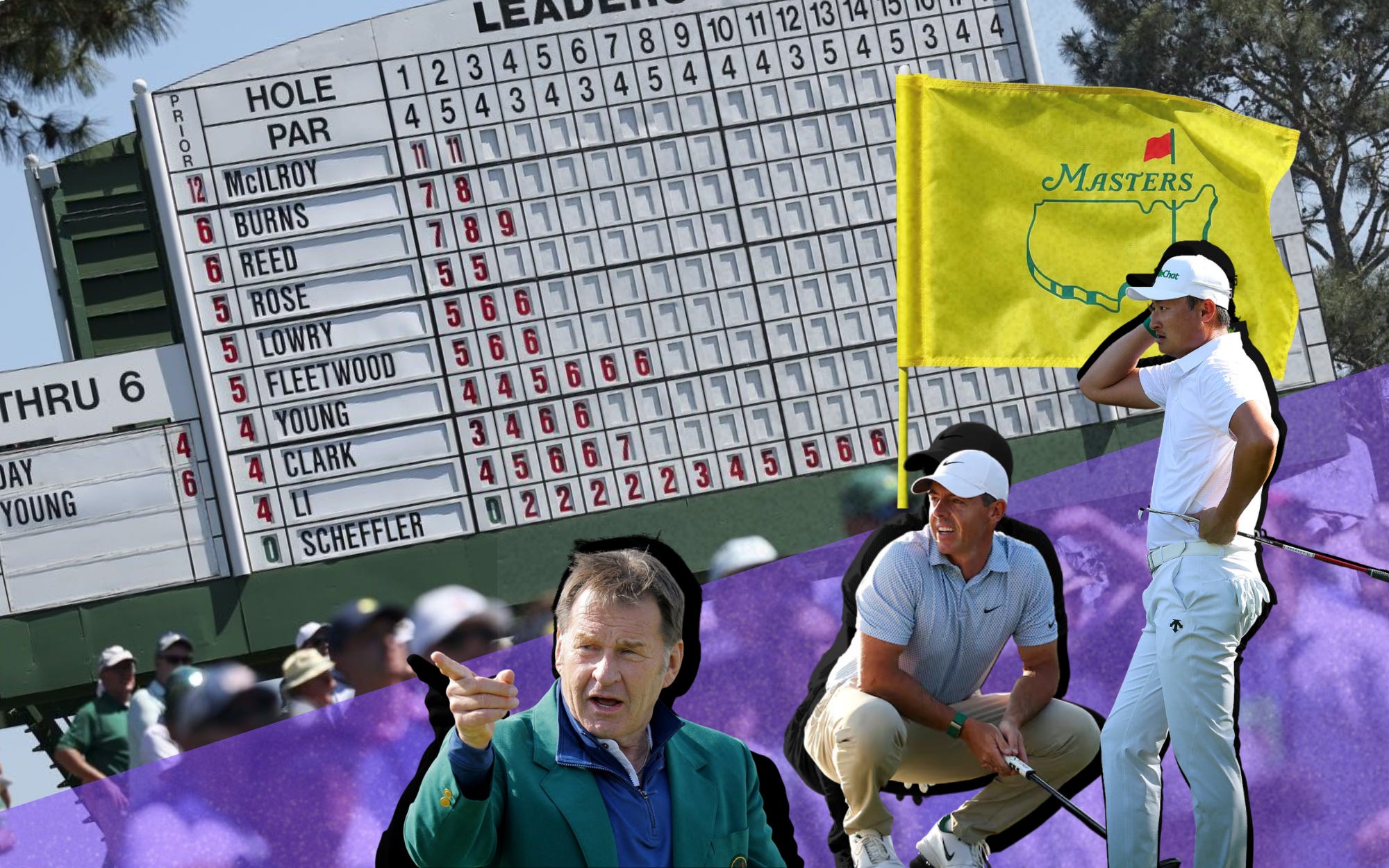
Beyond Rory McIlroy’s historic back-to-back Masters win last weekend, one of the main talking points coming out of the tournament was how it now exists in the modern content era.
“Content” feels like a dirty internet word at this point, but the Masters — something that once seemed to speak entirely for itself — has quickly become a content behemoth. For a tournament where phones are banned on course, it still drives an immense amount of clicks, views and attention.
Augusta National has made a concerted effort to enter a more digital age — the mobile app is now an annual ritual for the Masters acolyte, offering unrivalled replay and attention to detail on every single shot and every single hole. This year, the tournament had a renewed social media focus, providing plenty of content throughout the week on their various channels, beginning with behind the scenes footage of McIlroy’s Champions Dinner preparation, to neatly edited stories on Instagram threading through the on-course storylines. While the style wasn’t exactly to my taste and I found myself speed-tapping through them, clearly a lot of effort had gone into the format.
A bigger bone of contention was how mainstream components beyond the golf had become, as patrons transitioned from golf nerds into consumers and influencers, unpacking massive hauls of Masters merch on TikTok, revealing their extensive collections of caps and a garden gnome or two. At times it felt like a distraction, and although Augusta National have been criticised for leaving millions of dollars on the table through their somewhat archaic traditions, it’s something perhaps the board may consider reversing course on in future tournaments.
The Masters has always been wrapped in a mystique, but that is now being repackaged as a brand identity to be bought, displayed and circulated online. The tournament remains beautiful, but parts of the culture around it are beginning to resemble a luxury drop from a designer brand than a major championship, less a golf tournament that happens to have iconic branding, and more an iconic brand that happens to stage a golf tournament.
On television, ESPN entered the fray with their exclusive airing of the Par 3 tournament on Wednesday. It attempted to merge the Worldwide Leader’s increasingly Barstoolish tenor with the decorum of Masters week and although it was largely confined to the Par 3, it fed into a broader sense among pundits and hardened golf fans that this is exactly what they do not want the Masters to become — loud, boorish, and cluttered with unwelcome characters drafted in for comic relief.
Jason Kelce is a popular, louder-than-life character of this new ESPN era, but his involvement at Augusta was widely criticised. Although Pat McAfee was denied at the gate, it still felt as though ESPN failed to grasp the mood of the earnest golf fan. On the morning of day one, WWE wrestler The Miz was on hand to preview the tournament, in some awkward bit of cross-promotional synergy between ESPN’s coverage and this weekend’s WrestleMania. Needless to say, it went down like a lead balloon.
While this is more of an ESPN problem than an Augusta one, it does raise the question of whether stricter lines will be drawn in future. Augusta National chairman Fred Ridley made a rare admission in his once-a-year press conference last week that the club may have made a mistake in allowing Dude Perfect, the YouTube trick-shot troupe, to play frisbee around Amen Corner a few years ago.
Ridley noted that while Augusta is willing to explore themes outside its traditional box, there is clearly little appetite to veer too far into influencer and celebrity culture. Most golf fans still see the exclusivity of the Masters as something to be protected. Get the balance wrong between that and the gimmicks designed to capture more eyes, clicks and money, and the club risks alienating the true worshippers of Masters golf.
Beyond ESPN, the television coverage once again left plenty to be desired. It is well documented at this point just how limited live coverage of the golf remains, with early viewing restricted to specific featured groups and featured holes before broadening later in the day into the full broadcast window.
That approach leans into the supposed exclusivity of the course itself — you will see what we want you to see — and, in theory, whets the appetite for the main names and big storylines when the coverage finally opens up properly in the evening.
But there is a thin line between leaving viewers wanting more and simply excluding whole swathes of the tournament. Even when shots did make the air, the production often appeared to show them on a significant tape delay, sometimes several minutes after they had happened in real time. Several golfers disappeared into a black hole once they slipped down the leaderboard, with little effort made by television to colour in the wider picture and show how the tournament was unfolding beyond the top five or six names.
When Haotong Li was thrashing his way around Augusta National’s greenery en route to a quintuple bogey on the 13th, for instance, it was not even mentioned on television. Not only did it remove him from the top-five picture, it also had an impact on Scottie Scheffler, his playing partner, who viewers actually were following on screen.
Shane Lowry, near the top of the leaderboard for much of the tournament and still in the mix early on Sunday, eventually drifted out of contention with little effort made by television to tell that particular story, with only 19 of his shots finding airtime.
NBC analyst Kevin Kisner pulled no punches in his assessment of the coverage, openly baffled by CBS’s production decisions:
"Our production team at NBC prides themselves on playing every shot that they possibly can live… I have no idea what they’re doing. Literally no idea. They’re showing every shot on tape. I don’t even know how the announcers call it.
The problems escalated from there and left fans completely in the dark when production seemed to lose track of McIlroy’s second shot on the 18th. Needing at least a bogey to win the tournament, McIlroy ended up right of the fairway in the trees and recovered with a looping iron that finished in a bunker just short and right of the green. But for a good thirty seconds, neither the television pictures nor the commentary seemed entirely sure where the ball had gone.
All while this was happening, over on Sky Sports, Nick Faldo was mindlessly waffling on about how energy can be absorbed from the trees in moments like these. Faldo, long treated as one of the network’s authoritative Masters voices thanks to his Augusta pedigree and years in Sky’s golf orbit, can still sound more dutiful than illuminating. There is no questioning his stature or understanding of the course, but his television persona has often leaned toward the dry, aristocratic and faintly joyless, as though the audience is being lectured on the game rather than invited deeper into it.
For a tournament built on tension, that kind of commentary can flatten the drama rather than heighten it. Sky have long valued Faldo’s gravitas, but gravitas on its own is not always the same thing as insight. In a broadcast already constrained by Augusta’s rigidity, the last thing the viewer needs is another layer of distance between themselves and the event.
And that, really, is the modern Masters dilemma. Augusta is becoming less exclusive in the ways many golf fans never asked for — through TikTok haul culture, manicured social content and celebrity intrusion — while remaining just as restrictive in the one area viewers might actually welcome greater openness: the golf itself. In trying to preserve its mystique while broadening its commercial reach, the club risks drifting into an awkward middle ground: less formal, less sacred and less exclusive than before, yet still unwilling to let fans fully into the tournament they actually came to watch.