

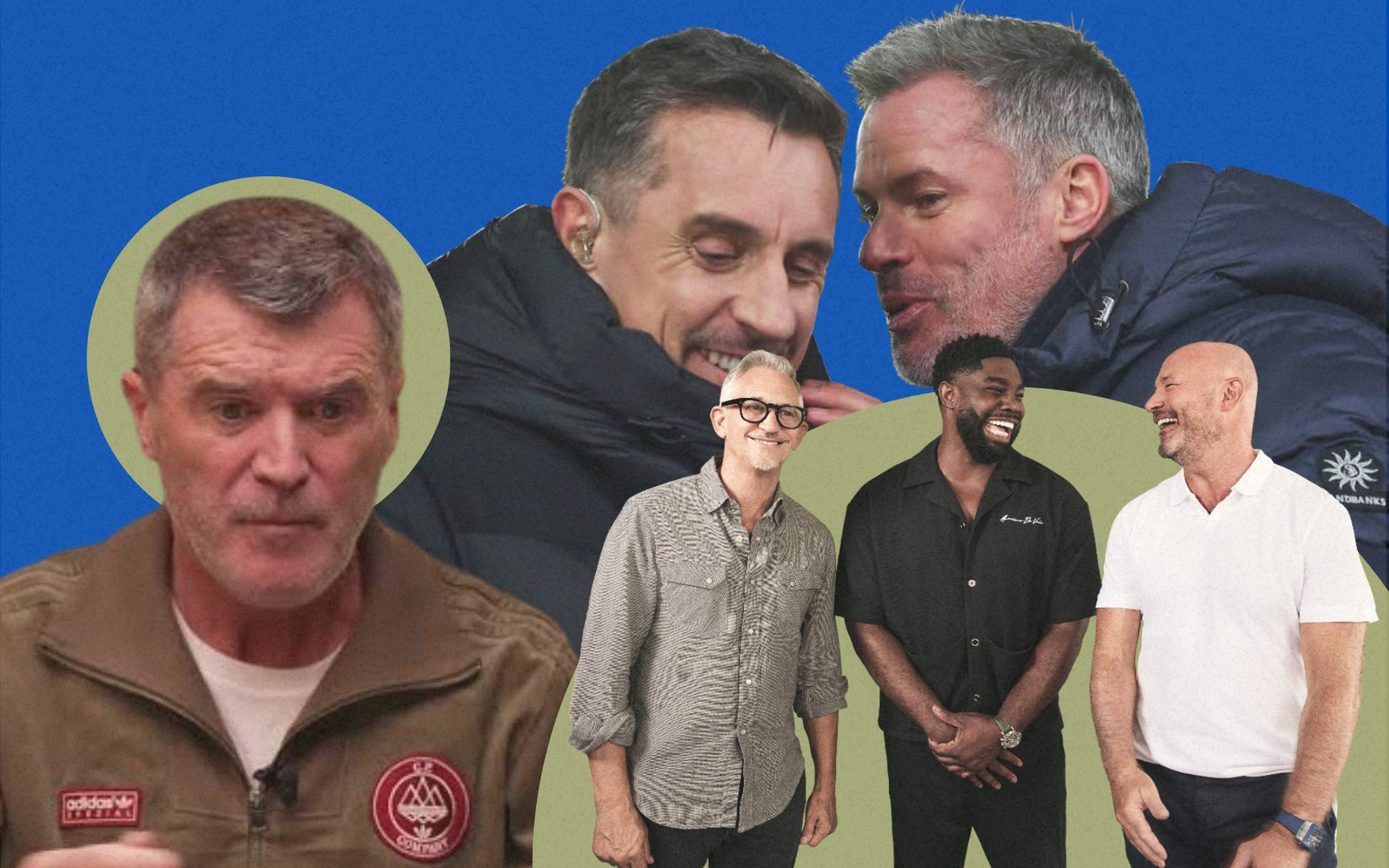
Browse deep enough into Netflix and you might stumble upon the former BBC trio Gary Lineker, Alan Shearer and Micah Richards, in their new podcast guise under the hugely successful Goalhanger banner, The Rest Is Football.
How or why Netflix decided to pick up and air a video version of the podcast is lost on me, but it’s the latest land grab from the increasingly stout and far reaching world of football content, which has become decentralized away from the major television productions and big rights broadcasters for spare room, crackly microphone efforts featuring some of football’s biggest names, or, in the case of The Overlap, their lavish, croissant crumb and Huel littered studios.
Goalhanger’s Tony Pastor said Netflix let the trio keep everything that makes the show what it is, including, oddly, Shearer’s extremely unsettling potty mouth.
Not enough to air their usually shallow views and even more surface level tactical insights, big name pundits are now more in our ears than ever, in all good podcast apps and YouTube algorithms. With more and more football comes more and more content. And, largely, it is worse than ever. And as ex-player led podcasts get picked up by big streaming platforms, the football content train is showing no signs of slowing down.
It cleverly parallels a similar rise in other genres of podcast turned video virality and sponsorship-laden productions, but most evidently it strides to match Gary Neville’s unbelievably successful Overlap production, which this season has found a new home on Disney+, following its free offerings on YouTube and shortform clip-cutting that is unavoidable online.
The pivot onto online streaming arrived along with the announcement that Wayne Rooney would be partnering with Mark Goldbridge, of Manchester United ragebait and viral reaction fame, to do their own United show called Stick To United. Yup.
Both arrived under a one-year exclusive sponsorship deal with Disney+, covering the 2026/27 season: forty new episodes of Stick to Football, twenty of them landing on Disney+ first, six more commissioned exclusively for Disney+ UK, and fifty episodes of the show with Rooney.
Neville’s line on the deal was that it “expands our reach without compromising our identity”, which is the kind of entrepreneurial mumbo-jumbo that you’d find on the latest Diary of a CEO episode.
And the BBC, seeing its current and former cabal of pundits joining various online competitors, has spent the summer building a football YouTube channel, with various different offerings — FANS², where supporters of rival clubs will debate, The Truth About Football, ninety-second animated explainers, Golden Goal, in which celebrities do skills challenges and Football Hub, a weekly tactical session.
Alex Kay-Jelski, the director of BBC Sport, says they want to put fans at the heart of “it”. With “it” I presume being the efforts to forge a piece of the lucrative shortform content feeds of Instagram and TikTok, and somehow tap into what the kids are doing online.
Football Focus died for this? In turn, what people’s hard-earned TV subscriptions and licence fee money delivers is a much worse and diluted product on screen. Gone is Football Focus, and Match of the Day increasingly becoming a relic of the past. This year has seen a reshuffle in the roster, following on from the Beeb’s underwhelming World Cup performance from a “green box” in Salford, as Lineker sniped at his former employers, with the national broadcaster struggling to deliver what football fans actually want in their coverage.
Ultimately, the question must be — who is any of this for?
Some of the shows are wickedly popular, with the likes of Stick To Football becoming weekly routine viewing/listening for many. Neville, Jill Scott, Ian Wright and Roy Keane have built a strong rapport through weekly reps, while attracting some big name guests along the way. But ultimately, much of their success stems from creating several viral 30-second clips, mostly off the back of either Keane’s comic timing or his character-driven temper. Oftentimes, they’re not even about football yet some observation on life, or interaction between the admittedly sincere bromance between Keane and Wright, as the cameras are left rolling as the group straddles into position, tucking into their bagels and orange juice.
But if you already watch Stick to Football for free, on YouTube, where it has always been, what does Disney+ give you? Twenty episodes a couple of days earlier and a longer version of a chat you were going to hear anyway, and will be all over your social media timelines within hours.
Pass The Remote II: The clickbaitification of football conversation

In recent weeks, a group of well known football journalists have decided to put the medium of podcast in their own hands in a new endeavour called “Libero”. Featuring the likes of Jonathan Wilson, Miguel Delaney and Rory Smith, it’s the familiar voices that you hear on an array of UK and Irish audio shows all in one place, chatting various elements of football in a ve…
Likewise, who is firing up Netflix to watch Shearer fill up a swear jar while Micah Richards heartedly guffaws in the background, all the while Lineker tries to maintain a semblance of professionalism on it all, but can’t nearly recapture the presenting aura he forged from the Match of the Day days?
With BBC living off public funding, Kay-Jelski’s stated philosophy is that you don’t need live rights to a sport to matter, and that the competition is for attention on a phone rather than eyeballs on a television. The numbers somewhat back that up, with broadcast viewing down about 8%, from a 5.9 million weekly peak to 5.4 million, while digital accounts accessing Match of the Day are up 32%, and BBC social media accounts capture upwards of 350 million views.
According to reports, suits have been briefing that Match of the Day is now a second-class product, and it’s hard to argue with them when you watch it. There’s a rotating cast of three presenters — Kelly Cates, Mark Chapman, Gabby Logan, all of them perfectly good — which means there is never a settled panel to build a rapport with, nor the sense that the group have put out dozens of shows together, as in times past when TV panels were very static.
Several new pundits have been added to the bill, such as Ashley Young, Robbie Keane and Thomas Frank, while a raft of old regulars have been shifted on, including veteran Martin Keown. And Shearer, the biggest name remaining after Lineker left in 2025, has asked to go from thirty-odd appearances a season to roughly one a month.
The BBC has decided its highlights show is a legacy asset and its YouTube channel is the new growth business, and is shifting things accordingly, while simultaneously pointing at Match of the Day’s audience figures when it needs to justify the licence fee. It’s hard to validate both arguments and running them at once is how you end up axing a show like Football Focus and commissioning a webshow where celebrities are taking penalties.
Television’s answer to the entire rise of online football content has been to get progressively worse. Sky have plopped a Saturday morning kick-off show with Roman Kemp hosting, which this past weekend welcomed Danny from The Script to join Jimmy Floyd Hasselbaink on an awkwardly tiny sofa. The show managed to be unbearably bland and Hasselbaink’s insights utterly depthless, while Danny caught some flack for claiming that Irish football fans generally support Manchester United or Liverpool which, if you’re from a certain era, isn’t necessarily false.
Soccer AM is another relic of the past, but there’s surely some scraps to pick from the ashes to make somewhat of a more fun and entertaining morning show to kick off the weekend of football? Live studio audiences, light hearted chat with a mix of ex-players and celebrity fans, decent analysis and preview of that weekend’s action? Surely anything is better than Hasselbaink trying to waffle on about the entire breadth of the Premier League.
Ultimately, the best offering anywhere all weekend came on Monday night, when Gary Neville and Jamie Carragher sat down in the only live football format that fans feel is delivering some semblance of bang for their buck.
Carragher dutifully broke down Liverpool’s problems across a twenty minute segment, that was sharper than everything else across the entire weekend of bland clichés. Monday Night Football is still the best thing on British football television and it’s still the best thing Sky Sports do by a distance. Following a very simple format that appeases the vast majority of viewers — analyse the biggest football moments, don’t treat us like idiots, and don’t force bad pundits and clickbait material upon us.
The problem is Sky’s most valuable format is also running on borrowed time. Neville has been stepping back from MNF for the last couple of years, and he’s getting more involved in The Overlap US and NBC, while still commentating on the main Super Sunday game and then checking with Wrighty and Co during The Overlap recordings.
The big football names in the country are either building their own companies or pivoting to podcasts, having their time divided across a range of mediums, and those spaces are now being targeted by the likes of Disney and Netflix.
As someone who consumes an unhealthy amount of football content, less and less of it is from these giants. BBC is letting Match of the Day fizzle to nothing. Sky Sports coverage is an embarrassment until it gets to Monday night. If something happens on The Overlap, I’m sure my WhatsApp groups will keep me updated, if the algorithm doesn’t get there first. And, frankly, I don’t know a soul who listened to Lineker, Richards and Shearer before they hit Netflix, let alone now.
So back to the question. Who is any of this for?
I've felt intensely alienated from top flight football for more than a year now, actually not bothering with the Premier League at all last season, and checking in on the ex-player punditry during the World Cup has reminded me why. I just find it uniformly shit. Pundits I used to like on in the background I cannot listen to any more. Neville, Keane, Shearer; they're all unbearable. Inane rambles no one would pay heed to without the names attached.
Reconnecting with my old podcasts and a new find has rekindled my relationship with the top flight; Stadio, Football Ramble, Adam Clery. I still mostly pay attention to the Championship and WSL though.
Without sounding biased, I think fans are creating significantly better content - be it blog, podcasts, vlogs - than what these commercial entities fronted by footballers are producing. They may look polished, they may attract significant advertising and investment, but you actually get better analysis from fans who put the time and effort into what is a labour of love for them first and foremost. While these ex-footballers are doing this to open up a new revenue stream after their playing careers have ended.
Don't get me wrong, I enjoy some of them, but you can tell those who are just going through the motions in the hope that the cheques follow. Does anyone use cheques nowadays???