

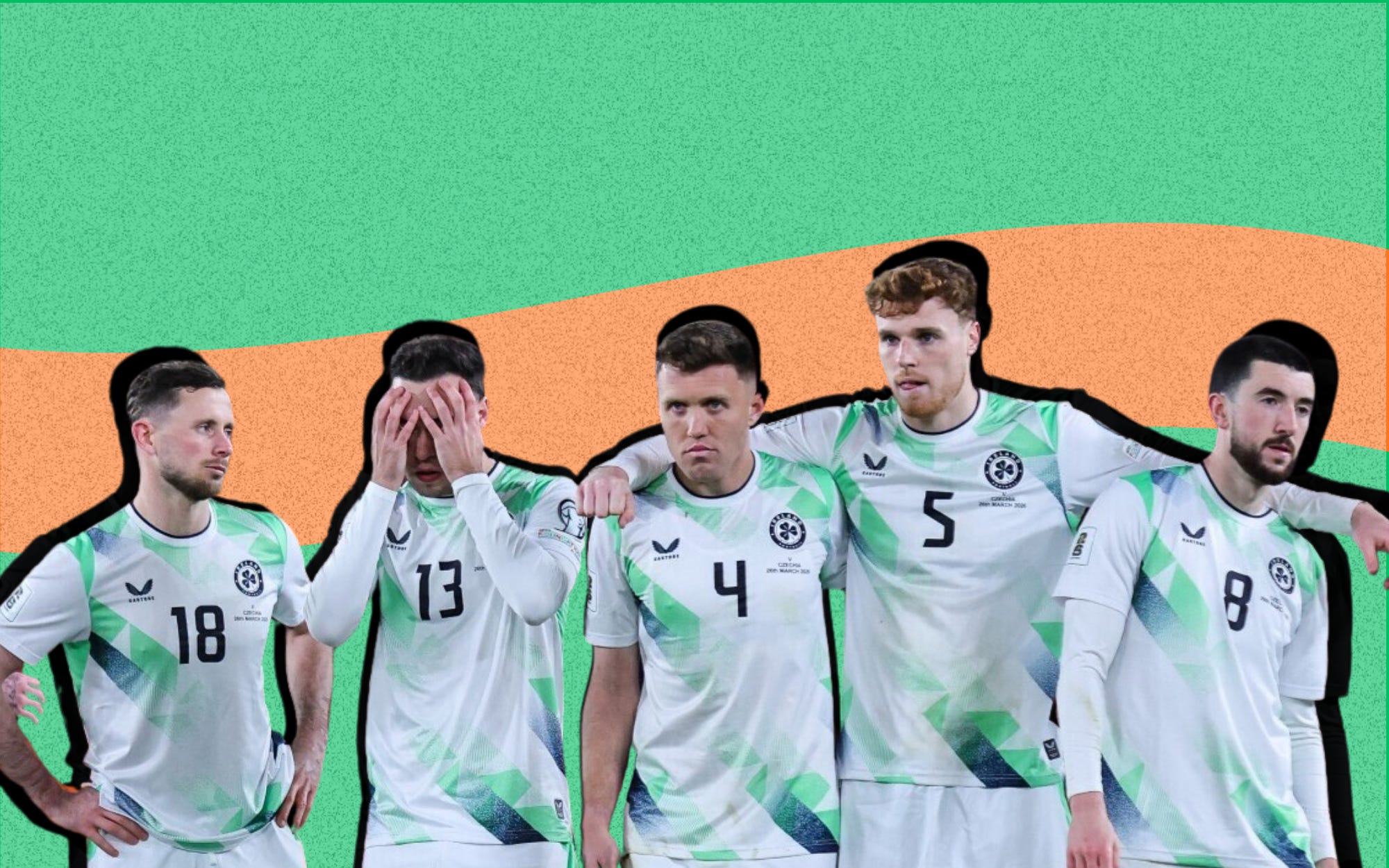
There is a particular kind of moment that only comes around once every four years, and it landed last weekend with me on the couch, remote in hand, once again lamenting that we had no skin in the game.
The World Cup is on. Ireland is not. So I sat and watched Curaçao, with a population somewhere around 150,000, a Caribbean island you could lose down the back of West Cork, walk out at a World Cup, and felt that very Irish thing that has never quite been given a word: delight for them and, underneath it, that low familiar ache for us.
We were telling ourselves this wouldn’t happen. The entire sales pitch for the 48-team World Cup, the bloated and sweating beast this newsletter has spoken about before, was that the door was being cast wide for countries like us.
More places, more nations, more fairytales. A bigger tent and more seats at the top table. The little guy would finally get a look in. And here is the part that refuses to sit nicely in the usual story, the one where FIFA is the villain and we are the wronged innocents at the gate: the door was widened, the fairytales did turn up, and Ireland still couldn’t enter through it.
Curaçao, the smallest country ever to reach the tournament. Cape Verde, an archipelago of barely half a million people, who topped a qualifying group with Cameroon in it - Cameroon, the five-time African champions, a country that has produced World Cup quarter-finalists and one of the great tournament folk heroes in Roger Milla. Jordan and Uzbekistan, in for the first time too. The expansion did exactly what it said on the tin and more. It found room for the unlikely and the unheralded. It still couldn’t find room for Ireland.
Because, after all, we are very good at being wronged. It is one of our better-developed muscles. The canonical Irish football grievance remains Thierry Henry’s handball in Paris in 2009, the volleyball assist that kept us out of 2010 and turned a generation into jurists on the laws of the game and supporters for some sort of video assistant solution. We had a villain then, a perfect one, a Frenchman with a guilty hand and a guilty face, and we have largely dined out on that injustice ever since. But even the faux-outrage that many have held onto has mostly dissipated. It is comforting, in its way, to lose to a crime. You get to keep your innocence. But it was over 16 years ago.
There was no crime in Prague. Heimir Hallgrímsson’s side went two goals up inside 23 minutes against Czechia in a World Cup play-off semi-final, the kind of start you spend your whole life as an Ireland supporter never quite believing in even as it happens. And then, of course, we did the thing. Ryan Manning did that in his own penalty box.
Patrik Schick pulled one back from the penalty spot. Ladislav Krejčí levelled the game with moments to go. Sammie Szmodics was carried off on a stretcher having been knocked unconscious. It went to extra time and then to penalties, where 4-3 was all it took to end it. They even missed a penalty before we did. No hand of Henry. No conspiracy. Just a two-goal lead handed back and quickly followed by shootout despair.
For years the implied defence was largely structural: too small a country, too shallow a pool, too many bigger fish swimming in the same European waters, the system stacked against the likes of us. And there’s truth in plenty of that. But when the system was changed in our favour, when the bar was lowered, the field was widened, and an extra play-off lifeline was strung across the gap - and Cape Verde, with fewer people than live in the Dublin commuter belt, managed to hurdle it. The excuses of being a small, underfunded football nation took a dent in Prague that it may not fully recover from.
The fact the Czechs have one point from their opening two games in a group that looks so desperately average just pours more alcohol into the wounds.
And so every fairytale on the screen this month doubles as a mirror to the Irish fanbase. Each time a debutant nation’s anthem plays and grown men weep into fresh replica shirts, it’s a lovely thing and also a small private indictment, a reminder that the romance of the underdog now belongs to other people’s underdogs.
Jack Charlton’s Ireland was the original good-time gatecrasher, the side that turned up where it had no business being and drank the place dry, and the whole country was brought along for the ride. Now we’re the ones at home, bitterly watching on at the likes of the Scottish doing the gatecrashing and reaping all the viral reward.
This is 24 years now since Saipan and Spain and the last time Ireland were actually at a World Cup. A whole footballing childhood has come and gone in the gap. There’s a whole cohort of Irish kids now who have never once seen their country at a World Cup, who will spend this summer watching Jordan and Uzbekistan and a Caribbean island of 150,000 people and wonder why that’s not us.
We pass down Italia ’90 and USA ’94 the way scripture gets passed down, the penalty save and the devastating Giants Stadium heat and the whole island grinding to a halt, a mere history lesson youngsters nod along politely to, little to no solace for them and their long-lasting World Cup absence.
And yet there is a strange and slightly shameful clarity to watching a tournament you’re not in. There is no pre-match dread, no national mood lurching on the back of a 1-nil defeat or late equaliser. You can enjoy Cape Varde for nothing, purely, the way you’re supposed to love a sporting underdog. For one more summer you are the neutral, and neutrality turns out to be a kind of peace - like waiting patiently and awkwardly in a quiet doctor’s office ahead of something grim like a rectal exam.
And yet every Irish supporter I know would trade that serene evening of sport for the sick one without a second’s thought, those jitterbugs where you can’t finish your dinner, where it feels like the entire island is tilting on its axis to every kick, tackle and wayward shot. To the feeling that it actually matters because we’re actually in it.
Being uninvited isn’t a higher form of dignity, even despite the grim and grotesque nature of this particular edition of the competition. It isn’t a clever opt-out from a tournament I’ve spent column inches calling out as ugly and obscene. It’s just being uninvited, and watching through the window, and pretending the view is better from out here.
I live in Athens, supporter of Panathinaikos that's why as a Panini kid liked Irish NT.Then, I found out extra reasons. I watched all these matches like an Irish dude. Don't get dissappointed, this LOI seems interesting and for sure something very good will be happened. Cheers
What hammered it home for me recently was thinking how did Scotland fans cope with the 28 year gap … and then quickly becoming melancholy that Ireland are looking at the same as a minimum now as well.
Have the greatest memories from Italia 90, USA 94, and 2002 … but I’m middle-aged now and wondering when the next one might be!