

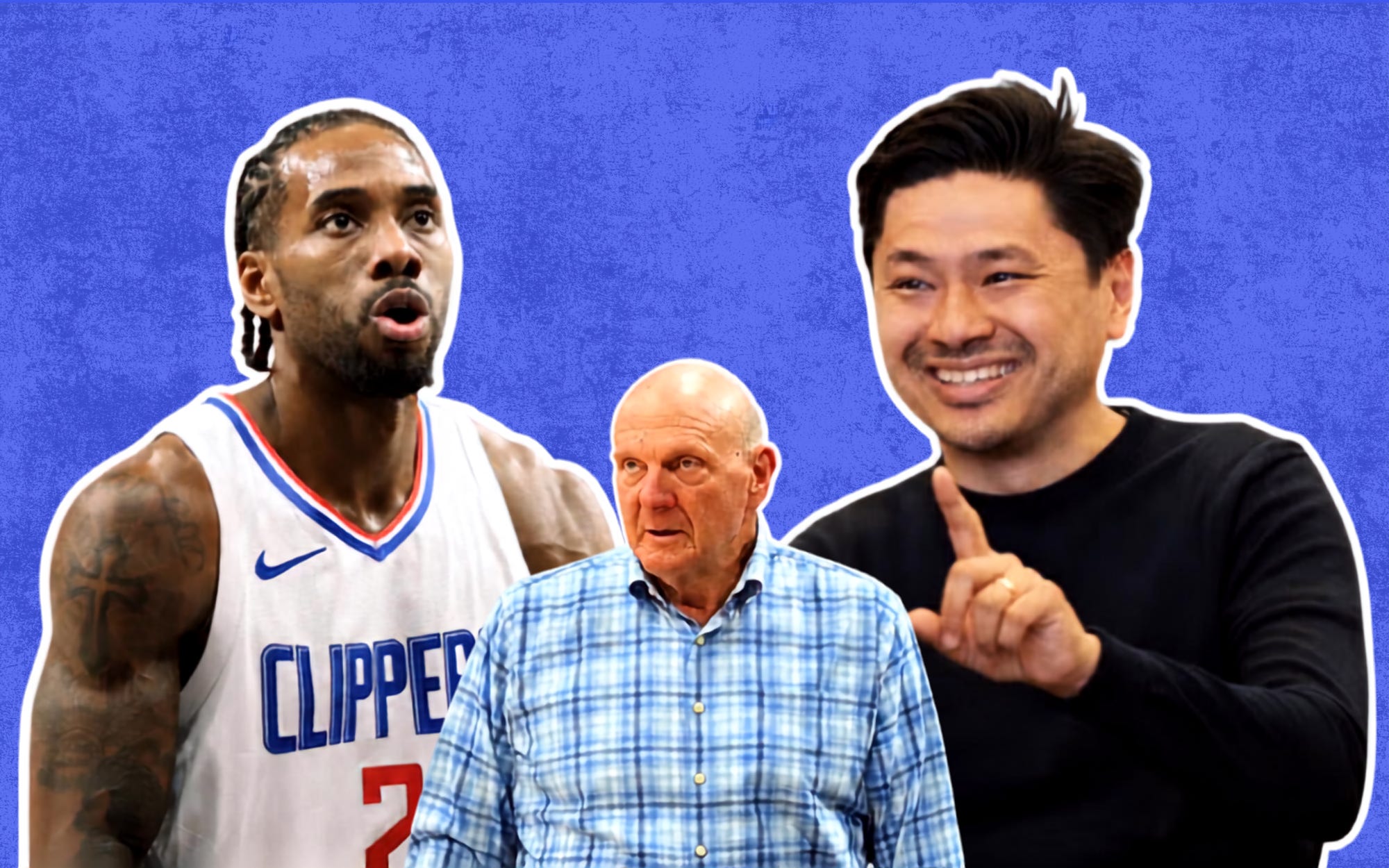
Last month, ESPN published a story reporting that the NBA had found no evidence that Steve Ballmer was funneling money through his Los Angeles Clippers sponsors to pay their superstar Kawhi Leonard.
Just two weeks later, the NBA laid down the hammer — stripping the Clippers of five first-round picks between 2029 and 2033, fining the franchise $30 million, suspending Ballmer from all league activity for a year, along with his business president Gillian Zucker for a year without pay and basketball president Lawrence Frank for six months.
The league fined Leonard $700,000, banned his uncle and business manager Dennis Robertson from dealing with any NBA team for five years, and installed a compliance monitor over the club until 2031. Adam Silver’s statement referred to “flagrant violations of our rules” and to “the Clippers’ institutional and leadership failures.”
For scale: when the Minnesota Timberwolves were caught running a secret $93 million side deal for Joe Smith in 2000, then-commissioner David Stern took away five first-rounders and $3.5 million, banning several Timberwolves personnel. That was the previous benchmark for the worst thing an NBA franchise had ever been caught doing as regards cooking the books for players, and it stood for twenty-six years.
The Clippers tinderbox was lit by former ESPN journalist and on-screen personality Pablo Torre. In his Pablo Torre Finds Out podcast, he and his team of investigative reporters revealed that Leonard had signed a $28 million endorsement deal with Aspiration Partners, a “sustainable finance” start-up that so-happened to be a Clippers sponsor, and that the deal required him to do nothing whatsoever beyond remaining a Clipper.
It was a bizarre arrangement, as Torre, across several longform YouTube videos, unveiled the evidence whilst insider experts laid out explanations and expertise into the story.
However, as grubby as it all seemed at first, the reporting was largely palmed away by more mainstream media enterprises, while online and in LA, sports fans were quick to write off Torre’s nous as a mere YouTuber poking at something that didn’t really warrant such a fuss — in many minds, it was simply rich folk doing rich folk things and, ultimately, didn’t really matter in the grand scheme of things.
But over the following twelve months, Torre kept pulling at the seam. He uncovered an undisclosed arrangement with Daktronics, the company that built the scoreboard hanging in the middle of Ballmer’s Intuit Dome, where a former contractor told him it was “1,000% a way to circumvent the salary cap.”
When the league’s own findings landed they named four companies: Aspiration, Boingo Wireless, Daktronics and Lockton Insurance. The Clippers, the NBA concluded, had been generating off-court income for Leonard, leaned on business partners to participate, and paid personal expenses for the player and his people, all outside of the league’s hardline salary cap.
Aspiration’s co-founder Joe Sanberg, by the way, is serving fourteen years in prison for a separate $248 million fraud scheme.
In May, the staff of Pablo Torre Finds Out won the Pulitzer Prize for Audio Reporting, the citation praising “a pioneering and entertaining form of live podcast journalism that investigated how the Los Angeles Clippers seemingly evaded the NBA’s salary cap rules by funneling money to a star player through an environmental startup.”
His reporting across various sports topics has been a welcome addition in the US sports media space. Where ESPN failed to see potential in what Torre brought to the table, the last of his offerings being an ill-fated midday debate show with another ESPN alumni, Bomani Jones, he’s brought a fiendish journalistic endeavour into an independent environment, giving him and his team the time and space to dig into actual stories, all while wrapping it up in an entertaining and often whimsical and lighthearted veneer for YouTube. Eventually, the show got picked up by The Athletic (New York Times).
Which brings us back to why the ESPN seemingly felt comfortable publishing the story that the Clippers investigation was running dry.
“What ESPN had done, according to my reporting, is they were fed a story by the Clippers that the Clippers may have known was not true,” Torre said afterwards.
On the Dan Patrick Show he put it more bluntly: “they got fed a story by the people who were lying to everybody this whole time and I got implicated as a result of that.”
Asked whether ESPN had apologised to Torre, he said he didn’t expect one, didn’t need one and didn’t deserve one. ESPN had asked him for a statement to include in the August piece. He gave them one — that he stood by his reporting and looked forward to the NBA’s ruling — and they conveniently didn’t run it.
As the story began to blow up following the NBA’s heavy response, there has been no correction. ESPN says it stands by the story and declined to comment any further. It was also followed up by reports from their NBA insider Shams Charania that Leonard had not been aware of any efforts by the Clippers to circumvent the salary cap, nor that he had knowingly been involved in sponsorship agreements, despite signed evidence to the contrary.
All in all, it’s been a disastrous couple of weeks for ESPN, and its own staff have stepped up to anonymously criticise what the leader in US sports coverage has become. It has been often under fire in the last few years, particularly as it continues shove away journalistic integrity for on-screen banter and brash personality from the likes of Pat McAfee and Stephen A. Smith.
One staffer described ESPN as being “more in bed with the leagues” and said “these types of stories seem to have been of less interest.” ESPN’s line is that it has “long operated on a separation of church and state when it comes to our journalism side and our business side, and that continues today.”
ESPN is in year two of an eleven-year rights deal with the NBA, part of a package worth $76 billion. In January the NFL closed on a 10% equity stake in ESPN, reported at somewhere around $3 billion, in exchange for NFL Network, RedZone and NFL Fantasy.
Dan Patrick, who spent eighteen years there, said “ESPN can’t be any further in bed with the NFL. Are they going to look the other way with any negative story that comes up?”
Pablo Torre Finds Out employs around a dozen people and came out of Meadowlark Media, Dan Le Batard’s company, another ex-ESPN personality. However, Torre owns the show. His reporting carries all the risk and, largely, its his head on the line to take on all criticism and pushback. But this story is a huge feather in his cap, and gives sports journalism a much needed bit of CPR. He is already teasing the next big story, potentially involving Mark Walter, the Lakers, the Dodgers and Magic Johnson.
Meanwhile, the Clippers will head to arbitration to fight the ruling and Ballmer and his team might be able to claw back some of those picks, and maybe get him back into the building before the end of the next season.
What the record will show, however, is that the biggest salary cap scandal in the history of American basketball wasn’t brought to shore by a mammoth news organisation with infinite resources; it was reported by a podcast, and in a small sliver of the sports media world — journalism continues to thrive.